
How Much Can a Vending Machine Earn in Singapore? The Honest Numbers
Real revenue maths for vending machines in Singapore — typical sales ranges, margins by product type, and the location factors that decide everything.
Wong Ryan
6/26/20264 min read
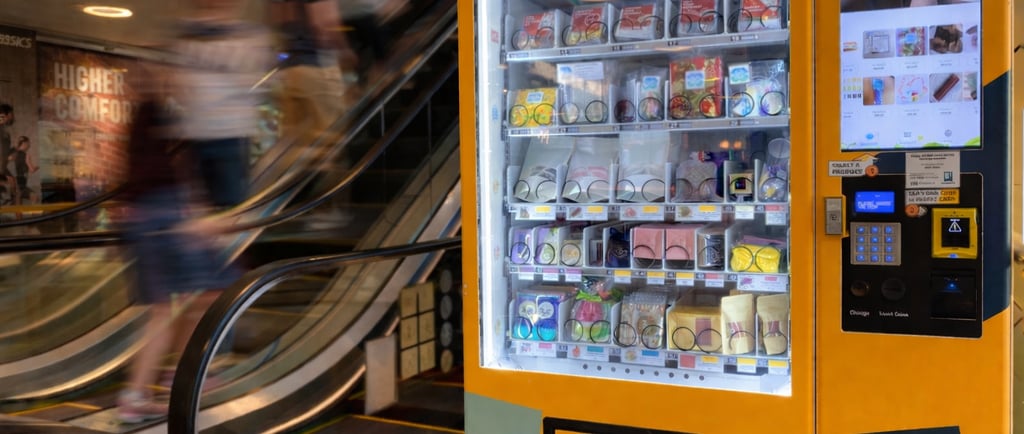
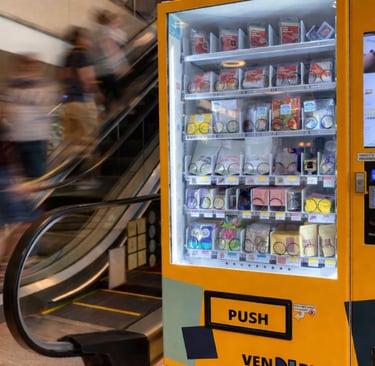
Search this question and you'll find articles promising thousands a month in passive income next to forum posts from owners barely covering electricity. Both are telling the truth. That's the thing about vending: the spread between a good machine and a bad one is enormous, and almost all of the difference is location.
We've operated machines in Singapore since 2017. Here's how the maths actually works, so you can estimate your numbers instead of borrowing someone else's.
The revenue equation
Vending revenue comes down to four variables:
Daily foot traffic × capture rate × average transaction × margin
Foot traffic is how many people pass within a few metres of the machine daily.
Capture rate is the percentage who buy. For drinks and snacks in a decent spot, think low single digits — 1% to 3% is normal. Captive locations (a factory floor with no nearby alternatives) capture far more than open locations (a mall corridor with a 7-Eleven downstairs).
Average transaction in Singapore runs S$1.50 to S$3 for drinks and snacks, and meaningfully higher for specialty products — fresh food, beauty items, electronics accessories and novelty machines can average S$5 to S$15 per transaction.
Margin on drinks and snacks typically lands between 30% and 50% of the sale price after product cost. Hot meals run tighter, around 20% to 35%. Specialty and own-brand products can run much higher, which is why brands using machines as a channel see different economics from snack operators.
What that produces in practice
Run the equation across typical Singapore scenarios:
A modest location — a mid-traffic office lobby or small workshop. Perhaps 15 to 25 sales a day at S$2 average. That's S$900 to S$1,500 in monthly revenue, leaving roughly S$300 to S$700 gross profit after product cost — before rental, electricity and space fees. At this level, the machine needs low fixed costs to make sense, which is why marginal locations suit profit-share arrangements rather than fixed rents.
A solid location — a busy workplace, school, gym or transit-adjacent spot. 40 to 80 sales a day pushes revenue to S$2,500 to S$5,000 a month, with S$1,000 to S$2,500 gross profit. This is the territory where a fixed rental, space fee and electricity are comfortably covered and the machine genuinely earns.
A prime or specialty location — high-traffic spots with the right product match, or specialty machines selling higher-ticket items. Monthly revenue of S$5,000 to S$10,000+ is achievable, and well-matched specialty machines (think customisation, novelty or premium products in entertainment districts) can earn more again. These locations are rare, contested, and usually already taken — which tells you something about the business.
The pattern worth internalising: the same machine, with the same products, can earn five times more or less depending on where it stands. Nothing else you optimise comes close to the location decision.
What separates the winners
Beyond raw footfall, four factors consistently show up in our better-performing placements:
Captivity beats traffic. Eight hundred office workers with no convenience store within five minutes outperform eight thousand mall walkers with options everywhere. Look for need without alternatives.
Product-audience match. A drinks machine at a gym sells isotonics and protein, not cola. A machine in a student area prices differently from one in a CBD tower. Generic product mixes leave money on the table everywhere they're placed.
Cashless, always. Singapore consumers increasingly don't carry cash. Machines with PayNow, cards and contactless capture sales that cash-only machines simply lose. There's no debate left here.
Uptime and stock discipline. Every hour a popular item sits sold-out is silent lost revenue. This is what telemetry is for — machines that report stock levels remotely get restocked when needed, not on a fixed schedule. The difference compounds over a year.
The costs that come out of "earnings"
To get from gross profit to actual profit, subtract:
Machine rental or purchase amortisation (S$250 to S$500/month for a managed rental)
Space fee if you don't own the location (commonly a few hundred dollars monthly in commercial buildings)
Electricity (S$50 to S$120/month for refrigerated machines)
ayment processing (1.5% to 3% of cashless sales)
Wastage on perishables (budget 3% to 5%)
Your time, or the cost of someone else's, for restocking
A solid location clears all of this with room to spare. A marginal one doesn't — which is why the pre-placement traffic assessment is the highest-value work in this whole business.
Two different games, two different answers
Notice that "how much can it earn" has different meanings depending on who's asking:
If you're building a vending business, the answer is the gross profit figures above, multiplied by however many good locations you can secure. The bottleneck is locations, not machines.
If you're a brand or business using a machine as a channel, direct machine profit understates the value. A machine selling your own product earns your full product margin, runs 24/7 brand visibility at the location, and feeds you sales data about what moves where. Several of our clients would keep their machines even at break-even on direct sales, because the machine is doing the job of a billboard and a stockist at once.
The realistic takeaway
A well-placed, well-run vending machine in Singapore is a genuinely good asset — steady income, low labour, scalable. A poorly placed one is a monthly bill with a screen. Before anyone quotes you projected earnings, ask them one question: what's the foot traffic and capture assumption behind that number? If they can't answer specifically, the projection is decoration.
If you have a location in mind, send it to us — we'll give you a realistic earnings estimate based on placements we've actually run, not a hopeful spreadsheet. Contact us or WhatsApp +65 9800 7373.